
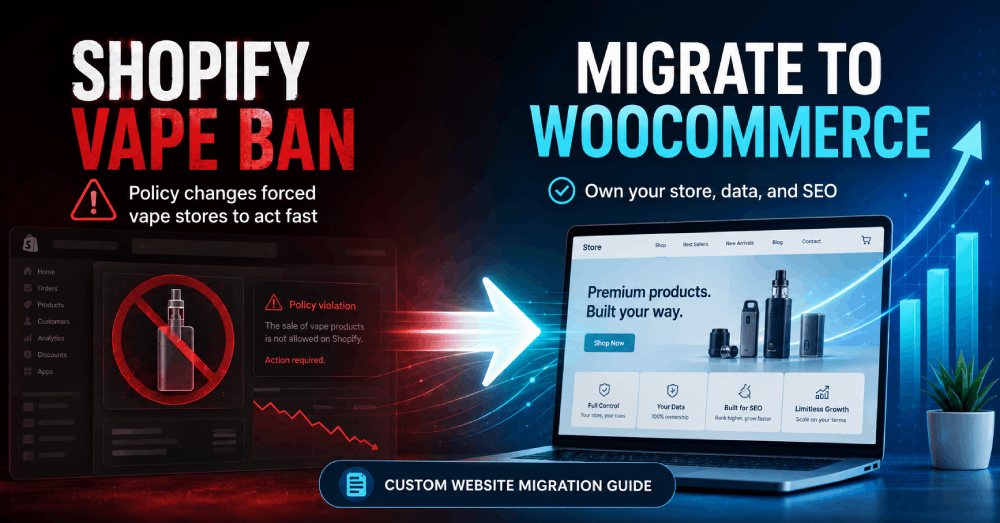
Shopify’s new policy requires affected merchants to remove vape and e-cigarette products or face product suspension or store termination. This detailed guide explains what changed, why moving to a custom WooCommerce website may be the strongest long-term option, and how to migrate without sacrificing products, customer records, order history, organic rankings, or conversion performance.
This is no longer a theoretical platform risk
Reuters reported that Shopify’s June 24, 2026 merchant notice instructed stores to remove all e-cigarette products by July 8, 2026 or risk product suspension or store termination. The policy applies to all vape products, and a spokesperson for the California Attorney General said the decision applies globally. Store owners should verify their individual Shopify notice and account status immediately.
For years, many vape, e-cigarette, e-liquid, nicotine, and related-accessory businesses used Shopify because it offered fast setup, a polished admin dashboard, reliable hosting, and a large app ecosystem. That convenience created a hidden strategic dependency: the storefront, checkout, hosting environment, application access, and platform rules were all controlled by one hosted software provider. In June 2026, that dependency became a direct business-continuity problem for vape merchants.
On June 23 and June 24, 2026, government announcements from California and Illinois described Shopify’s decision to ban the sale of all vaping products, including e-cigarettes, through its ecommerce platform. Reuters later reported that Shopify sent merchants a June 24 notice saying it no longer supported the sale of Electronic Nicotine Delivery Systems, commonly called ENDS. The notice required removal by July 8, 2026 and warned of product suspension or store termination. Reuters also reported that the new policy covers all vape products rather than only products lacking authorization.
The immediate question for an affected merchant is not simply, “Which Shopify alternative should I choose?” The real question is, “How do I protect revenue, customer data, organic traffic, operational continuity, and compliance while moving away from a platform that can no longer support my catalog?” A rushed migration can keep a store online but destroy years of SEO equity, break product URLs, lose order records, interrupt subscriptions, disconnect email automation, and create a checkout that a payment provider will not approve.
What exactly changed with Shopify and vape products?
The most important point is that this is broader than a Shopify Payments limitation. Shopify’s own compliance documentation has long explained that merchants must follow the Shopify Terms of Service, the Acceptable Use Policy, applicable laws, and separate terms for additional products such as Shopify Payments. In other words, a store can face different layers of restriction: the core platform, the payment service, international selling tools, app distribution, and local law.
Before the 2026 change, some merchants assumed they could remain on Shopify by disabling Shopify Payments and connecting a third-party high-risk payment processor. That assumption is no longer safe for vape catalogs covered by the new platform policy. According to the merchant notice reported by Reuters, Shopify itself no longer supports the affected ENDS products. Changing the gateway does not solve a platform-level prohibition.
Shopify’s Managed Markets documentation separately lists tobacco and tobacco-related products as restricted, including cigarettes, cigars, e-cigarettes, nicotine products, and other tobacco-related items. That restriction applies specifically to Managed Markets, while the June 2026 notice reported by Reuters concerns broader Shopify platform support for vape products. Store owners should not confuse these two layers. The new risk is not merely that certain products cannot be sold internationally through a managed cross-border feature; it is that affected vape products may no longer be supported on the underlying store.
Does the Shopify vape ban include legal or authorized products?
Reuters reported that Shopify’s new policy applies to all vape products. Its earlier June report said the planned U.S. ban would include products regardless of whether they had FDA marketing authorization. The July follow-up reported that the policy applies globally and that Shopify instructed merchants to remove all e-cigarette products. This means a merchant should not assume that licenses, age gates, product authorization, or use of a non-Shopify payment processor will automatically exempt the store.
The safest operational response is to read the exact notice received in Shopify Admin, save a copy, contact Shopify Support for account-specific clarification, and prepare an independent migration immediately. An appeal may be appropriate where Shopify has misclassified a product, but a business-continuity plan should not depend entirely on an appeal whose timing or outcome is uncertain.
What products may be affected?
The language reported publicly focuses on vaping products, e-cigarettes, and ENDS. Depending on how Shopify classifies a catalog, affected inventory may include complete devices, disposable vapes, refillable systems, e-liquids, nicotine-containing products, cartridges, pods, coils, replacement components, and products presented primarily for vaping use. The treatment of batteries, empty hardware, non-nicotine products, general electronics, merchandise, or unrelated accessories may depend on classification and the individual notice.
Mislabeling products, hiding keywords, using deceptive descriptions, or moving checkout off-platform while continuing to use a prohibited hosted storefront can increase legal, payment, and account risk. Build a legitimate replacement operation with accurate catalog data and documented compliance.
What vape merchants should do immediately
The first objective is preservation. Before changing products, uninstalling apps, canceling Shopify, or editing the domain, create a complete evidence and data package. Shopify exports do not automatically produce a perfect, restorable copy of the entire business. Product exports can reference image URLs instead of embedding image files. Customer passwords cannot be exported. App data may live outside Shopify. Subscription contracts, loyalty points, reviews, bundles, metafields, redirects, blog layouts, and email flows may require separate exports or API retrieval.
Do not cancel the Shopify subscription until the replacement store has been tested, the domain cutover is complete, critical data has been verified, and a secure archive exists. Even if product selling has stopped, temporary read access may remain valuable for reconciling orders, refunds, chargebacks, customer service, tax records, and migration discrepancies.
Why WooCommerce is a strong Shopify alternative for vape businesses
WooCommerce is an open-source ecommerce platform built on WordPress. Official WooCommerce materials emphasize control over checkout, data, costs, payment choices, features, and hosting. The WordPress.org plugin listing states that merchants retain ownership of store content and data, while WooCommerce’s migration documentation specifically supports moving products, customers, orders, design, and functionality from Shopify.
That architecture is strategically different from a fully hosted software-as-a-service platform. With a self-hosted WooCommerce store, the merchant chooses the hosting company, database environment, theme, codebase, extensions, payment integration, age-verification provider, analytics setup, and development team. The business is not dependent on one ecommerce software vendor for every layer of the operation.
However, “self-hosted” does not mean “restriction-free.” WooCommerce is software, not a legal exemption, bank, card network, shipping carrier, or universal hosting guarantee. A hosting provider can still have an acceptable-use policy. A payment processor can still classify vape or nicotine transactions as prohibited or high risk. Card networks and acquiring banks can still require enhanced underwriting. Shipping providers can still refuse certain products or destinations. Governments can still prohibit sales, impose age restrictions, require registrations, restrict flavors, or mandate tax and reporting obligations.
WooCommerce reduces single-platform dependency. It does not remove the obligation to operate lawfully and satisfy every provider in the transaction chain.
Codefreex ecommerce architecture principleWhat control does WooCommerce provide?
- Hosting choice: Select infrastructure based on traffic, geography, data requirements, risk profile, and provider policy instead of using a mandatory platform host.
- Database ownership: Maintain direct access to product, order, customer, content, and configuration data, subject to privacy and security requirements.
- Custom checkout: Build age confirmation, restricted-location logic, tax rules, shipping validation, required declarations, and gateway routing around approved business requirements.
- Payment flexibility: Integrate a processor that has explicitly approved the merchant category, products, jurisdictions, and transaction model.
- SEO flexibility: Control metadata, content, structured data, internal links, landing pages, redirects, canonicalization, and technical SEO at code level.
- Design freedom: Rebuild the storefront around trust, product discovery, education, mobile conversion, and repeat purchase rather than accepting theme limitations.
- Integration freedom: Connect ERP, CRM, email, SMS, warehouse, tax, identity, analytics, subscription, and compliance services through plugins, APIs, webhooks, or custom development.
Shopify vs WooCommerce after the 2026 vape policy change
| Decision factor | Shopify for affected vape products | Self-hosted WooCommerce |
|---|---|---|
| Core platform support | The reported June 2026 notice says Shopify no longer supports affected ENDS products. | Open-source software can be installed on an independently selected host, subject to host policy and law. |
| Hosting control | Shopify controls the hosted platform infrastructure. | Merchant selects and can change hosting providers. |
| Data access | Data can be exported, but formats and app data vary. | Direct database and file-level control is possible. |
| Checkout customization | Limited by Shopify plans, policies, APIs, and platform architecture. | Highly customizable through plugins, hooks, APIs, and custom code. |
| Payment processing | A gateway change does not solve a platform-level product prohibition. | Merchant can integrate an approved high-risk processor, but approval is still mandatory. |
| SEO control | Strong baseline features but platform-controlled URL and technical architecture. | Extensive control over URLs, schema, content, redirects, templates, and server configuration. |
| Maintenance | Core hosting and platform updates are managed by Shopify. | Merchant or agency must manage updates, security, backups, performance, and monitoring. |
| Strategic dependency | High dependency on one hosted commerce provider. | Responsibility is distributed across software, host, developer, gateway, and operational vendors. |
The complete Shopify vape store to WooCommerce migration plan
A professional migration should be treated as a controlled re-platforming project, not a CSV upload. The objective is to reproduce or improve the complete revenue system: catalog, inventory, content, search, customer accounts, orders, subscriptions, promotions, checkout, tax, shipping, compliance, analytics, automation, and SEO.
Emergency discovery
Assess the Shopify notice, catalog scope, jurisdictions, revenue-critical functions, provider approvals, data volume, SEO exposure, and realistic launch priority.
Architecture and compliance
Select hosting, approved payment processing, age verification, shipping logic, tax configuration, security controls, backup strategy, and required legal content.
Store build and migration
Develop the WooCommerce storefront, transform product data, migrate customers and orders, rebuild integrations, and reproduce important merchandising logic.
Testing and cutover
Run end-to-end QA, validate checkout restrictions, import final deltas, deploy redirects, switch DNS, monitor errors, and reconcile live orders.
1. Build a migration inventory
Start with a structured workbook that lists every Shopify object and the destination in WooCommerce. Include product titles, handles, variants, SKUs, barcodes, prices, compare-at prices, inventory, vendors, categories, tags, product types, collections, descriptions, images, videos, metafields, SEO titles, meta descriptions, related products, bundles, subscriptions, and reviews. Do the same for customers, orders, refunds, discounts, taxes, shipping profiles, locations, gift cards, pages, blogs, navigation, forms, and app-managed data.
This inventory prevents the most common migration failure: believing the product CSV represents the whole store. It does not. A profitable ecommerce operation is a network of data and behavior. If the original site uses a review app, a subscription app, a loyalty app, an advanced search app, a wholesale portal, or a warehouse integration, each system requires its own migration or replacement plan.
2. Choose infrastructure before moving data
Hosting should be selected based on more than price. The host must permit the lawful business model under its terms, provide sufficient CPU and memory for WooCommerce, support current PHP and database versions, allow staging environments, offer automated backups, support a web application firewall, and provide responsive incident support. High-traffic stores may require isolated resources, object caching, a content delivery network, image optimization, database tuning, and controlled deployment workflows.
The production architecture should include separate staging and live environments. Migration scripts, plugins, theme changes, gateway updates, and bulk imports should be tested on staging. Direct experimentation on the live site can corrupt orders, trigger emails, create duplicate customer records, or expose unfinished compliance logic.
3. Confirm payment processing before launch
Payment acceptance is often the hardest dependency for a regulated ecommerce business. Do not build the entire store and then ask a generic gateway for approval. Obtain written confirmation from the acquiring bank or processor that it supports the exact products, business entity, fulfillment model, target locations, average transaction value, subscription model, and expected volume. Ask about reserves, payout timing, chargeback thresholds, prohibited jurisdictions, required descriptors, recurring billing, fraud controls, and termination conditions.
A processor may approve general tobacco-related merchandise but reject nicotine liquids, disposable vapes, cross-border orders, subscriptions, or products without specified authorization. “We support high-risk ecommerce” is not enough. The approval must match the real catalog and operating model.
4. Design a compliance-first checkout
A simple “I am over 18” popup is not automatically sufficient. The required controls depend on the countries, states, provinces, and localities served. A compliant architecture may require age assurance, identity verification, date-of-birth collection, shipping-address validation, restricted-postcode rules, adult-signature requirements, product-specific notices, marketing consent records, tax treatment, licensing checks, and auditable order logs.
These controls should be integrated into product eligibility, cart validation, checkout, payment authorization, fulfillment, and customer communication. For example, a customer should not be able to add an ineligible product, bypass a location block with an express checkout button, select a prohibited shipping service, or complete payment before required age and identity checks.
A legal-policy page alone cannot stop a technically invalid order. The website should enforce approved business rules at the catalog, cart, checkout, payment, and fulfillment levels.
5. Migrate products and variations carefully
Shopify and WooCommerce structure variable products differently. Shopify exports often repeat rows for variants, while WooCommerce commonly uses a parent variable product with child variations. Product handles can become WooCommerce slugs, but collections may need to become categories, tags, brands, or custom taxonomies. Metafields may map to attributes, custom fields, product tabs, compliance fields, or custom database structures.
Before the full import, create a small test batch containing simple products, variable products, sale prices, out-of-stock items, products with multiple images, products with special shipping requirements, and products with unusual characters. Validate every field, image, SKU, variation, tax class, inventory number, category, and URL. Only then run the complete import.
Product media deserves separate attention because Shopify CSV exports may contain URLs rather than embedded image files. Download and re-host important assets in the WordPress media library or an approved media architecture. Do not assume Shopify CDN URLs will remain a permanent source after the account is closed.
6. Migrate customers and orders without creating privacy risk
Customer data should be transferred securely, minimally, and lawfully. Limit access to authorized team members, encrypt exports, maintain version control, and remove temporary files after validation. Customer passwords generally cannot be exported from Shopify, so customers may need to activate a new account or reset their password on WooCommerce.
Historical orders are valuable for support, reporting, loyalty segmentation, warranty records, repeat-purchase analysis, and tax reconciliation. Imported orders should preserve original order numbers where practical, timestamps, currencies, line items, discounts, taxes, shipping, customer addresses, payment status, fulfillment status, refunds, and notes. Imported records should not trigger accidental shipment emails or revenue events in analytics.
7. Rebuild subscriptions, loyalty, reviews, and automation
Subscriptions cannot always be moved as active billing agreements because payment tokens belong to the original gateway and are protected by strict security rules. The new processor, old processor, and subscription platform must determine whether token migration is possible. Where it is not possible, customers may need to reauthorize payment details through a secure campaign.
Reviews should preserve reviewer names, dates, ratings, verified-purchase status where valid, product relationships, images, and moderation status. Loyalty migration should preserve points, tiers, referral balances, and expiry dates. Email and SMS flows should be rebuilt with new WooCommerce events and tested so customers do not receive duplicate welcomes, abandoned-cart messages for imported carts, or order notifications for historical orders.
How to migrate without destroying SEO
Organic traffic is often the second-largest asset after the customer database. A careless migration can remove that asset in a single DNS change. Shopify and WooCommerce generate different default URL patterns, collection structures, pagination behavior, canonical tags, and structured data. Every valuable old URL needs an intentional destination.
Create a URL-level redirect map
Crawl the Shopify site before shutdown and export every indexable URL. Combine that crawl with Google Search Console landing-page data, GA4 organic landing pages, backlink reports, paid-ad destinations, email links, and sitemap URLs. Map each old product, collection, page, and blog URL to the closest relevant new destination. Use a direct one-to-one 301 redirect whenever possible.
Do not redirect every removed page to the homepage. Search engines and users interpret irrelevant redirects poorly. If a product has a true replacement, redirect to that replacement. If a collection structure changes, redirect to the new equivalent category. If content remains useful, rebuild it at a corresponding URL. If no relevant destination exists, a deliberate 404 or 410 may be cleaner than a misleading redirect.
Preserve high-performing content and metadata
Keep product titles, substantive descriptions, category copy, buying guides, FAQs, educational articles, image alt text, internal links, SEO titles, meta descriptions, and structured data where they are accurate and compliant. Improve thin or duplicated content during the migration, but avoid rewriting every ranking page at the same moment the platform, URL, design, and internal linking all change. Too many simultaneous variables make traffic loss difficult to diagnose.
Control canonical tags, schema, and indexation
The WooCommerce site should generate clean canonical URLs, XML sitemaps, product schema, organization schema, breadcrumb schema, article schema, and appropriate indexation rules. Filter pages, internal search results, account pages, cart, checkout, duplicate variations, and tracking parameters should be reviewed so they do not create crawl waste or duplicate content.
Before launch, confirm that staging is blocked from search engines. At launch, confirm that production is indexable. This sounds basic, but accidental “Discourage search engines” settings and inherited noindex tags are common causes of post-migration traffic collapse.
Launch with a measurement plan
- Verify the new domain property and URL-prefix property in Google Search Console.
- Submit the new XML sitemap.
- Monitor 404 errors, redirect chains, excluded pages, canonical conflicts, and crawl activity.
- Compare rankings, clicks, impressions, indexed pages, revenue, and conversion rate by landing page.
- Validate GA4 ecommerce events, ad pixels, consent behavior, affiliate tracking, and call tracking.
- Keep the redirect map under version control and correct missed URLs quickly.
When redirects, taxonomy, content, schema, speed, internal linking, and mobile UX are engineered correctly, re-platforming can improve crawlability and conversion instead of merely preserving the old store.
Codefreex provides dedicated website migration services, WooCommerce development services, and ecommerce store optimization for businesses that need a controlled transition rather than an automated one-click import.
Why a custom WooCommerce vape website is better than cloning the Shopify store
An emergency migration does not have to reproduce every visual detail of the Shopify theme. The strongest approach is to preserve brand recognition and proven conversion elements while rebuilding the experience around the new operating reality.
A custom vape ecommerce website can prioritize product education, adult-focused presentation, transparent ingredients or specifications, trust signals, brand verification, shipping eligibility, account history, reorder flows, and customer support. It can also separate product families with different compliance or fulfillment requirements instead of forcing the entire catalog through one generic template.
Conversion features worth rebuilding intentionally
- Fast mobile navigation with clear categories, brands, device types, compatibility, and stock status.
- Predictive search that recognizes SKUs, brand names, compatible coils, device families, and common misspellings.
- Structured product specifications for capacity, resistance, compatibility, ingredients, warnings, package quantity, and other lawful product details.
- Verified product reviews and question-and-answer content.
- Reorder tools based on previous WooCommerce orders.
- Bundles and cross-sells that respect product compatibility and transaction rules.
- Location-aware product availability and shipping options.
- Clear delivery estimates, adult-signature information, returns rules, and support access.
- Optimized checkout with fraud controls and minimal unnecessary friction after required verification.
- Accessible design, strong Core Web Vitals, secure forms, and privacy-aware analytics.
Codefreex can deliver this through its custom ecommerce development services, UI/UX design services, and full-stack development services. The goal is not simply to move a catalog. It is to rebuild a resilient sales system that the merchant can control and evolve.
How long does a Shopify-to-WooCommerce vape migration take?
The correct timeline depends on urgency, catalog size, data quality, app complexity, payment approval, compliance requirements, integrations, and design scope. A small catalog with a simple checkout can move much faster than a multi-country store with subscriptions, thousands of variants, wholesale pricing, multiple warehouses, loyalty balances, and custom ERP workflows.
| Migration type | Typical scope | Main risk | Recommended approach |
|---|---|---|---|
| Emergency continuity launch | Priority products, approved payment method, essential policies, restricted-location logic, basic shipping, and core pages. | Launching too quickly without complete compliance or data validation. | Launch a controlled minimum viable storefront, then migrate secondary features in phases. |
| Standard full migration | Complete catalog, customers, historical orders, content, reviews, redirects, analytics, automation, and redesigned templates. | Data mismatches and hidden app dependencies. | Use a staged build with test imports and formal acceptance testing. |
| Complex custom re-platforming | Subscriptions, B2B, ERP, multiple warehouses, custom pricing, regional catalogs, advanced compliance, and headless components. | Integration failure or operational downtime. | Use an architecture phase, integration test environment, delta migration, and launch runbook. |
Payment underwriting can become the critical path. A development team may be able to build a storefront quickly, but it cannot force a bank, acquirer, gateway, host, carrier, or regulator to approve a business. Start provider validation on day one.
What determines the cost of migration?
A credible quote should be based on the current store rather than a generic product count. Two stores with 500 products can have completely different complexity. One may contain simple products and a basic checkout; the other may have ten variations per product, subscription contracts, custom metafields, wholesale tiers, bundle logic, review media, multiple currencies, and a warehouse API.
Cost is generally influenced by:
- Number of products, variants, images, videos, collections, pages, blog posts, customers, and orders.
- Condition of exported data and the amount of transformation or deduplication required.
- Need to preserve historical order numbers and detailed transaction records.
- Complexity of subscriptions, loyalty, gift cards, reviews, wholesale, and marketplace connections.
- Custom age-verification, address screening, restricted-location, tax, and shipping logic.
- Payment gateway integration and any processor-specific hosted fields or API requirements.
- Custom UI/UX design versus adaptation of an existing WooCommerce theme.
- SEO crawl size, redirect mapping, structured data, content migration, and post-launch monitoring.
- ERP, POS, CRM, accounting, inventory, email, SMS, affiliate, and fulfillment integrations.
- Required hosting architecture, performance optimization, security hardening, backups, and maintenance.
The cheapest migration is often an automated import that moves visible product records. The most valuable migration preserves the business model. When evaluating proposals, ask exactly how the team will handle redirects, customer accounts, order history, media ownership, variation mapping, app data, payment approval, age verification, tracking, backups, and rollback.
Common mistakes vape stores make during an emergency migration
Waiting for the Shopify account to be terminated
Once access is limited, exports, app retrieval, theme downloads, media collection, and API extraction may become harder. Begin preservation and planning while admin access is available.
Assuming WooCommerce itself approves the products
WooCommerce is open-source software. The merchant still needs lawful products, suitable hosting, approved payment processing, compliant shipping, proper taxes, security, privacy controls, and jurisdiction-specific operating procedures.
Choosing a payment gateway based only on a plugin listing
A WooCommerce plugin proves technical compatibility, not merchant approval. Obtain written underwriting approval before relying on the gateway.
Importing Shopify data directly into production
Unclean CSV files can create duplicate products, broken variations, incorrect stock, malformed descriptions, missing images, and invalid prices. Test, transform, validate, and back up first.
Changing every URL without redirects
This can erase search visibility, backlinks, affiliate traffic, saved customer links, and campaign performance. Build a page-level redirect map and test it before DNS cutover.
Recreating only the visible design
The storefront may look complete while critical workflows are missing: tax, fraud screening, subscription renewal, post-purchase automation, warehouse routing, customer service history, or restricted-location validation.
Using too many plugins without architectural review
WooCommerce flexibility can become technical debt when every requirement is solved with another plugin. Overlapping extensions can slow checkout, create security exposure, conflict during updates, and make debugging expensive. Use reputable extensions and custom code only where justified.
Launching without backups, monitoring, or rollback
The first days after launch can reveal redirect gaps, gateway edge cases, caching errors, email problems, tax discrepancies, and inventory synchronization issues. Maintain database backups, logs, uptime monitoring, transaction monitoring, and a documented incident process.
How Codefreex handles a Shopify vape store migration
Codefreex approaches the project as ecommerce risk reduction and revenue recovery. We first identify what must remain operational, what data must be preserved, what provider approvals are required, and which pages produce organic traffic or sales. We then build the migration around measurable launch criteria.
- Rapid audit: Review the Shopify store, policy notice, product scope, integrations, traffic, conversion paths, exports, and operational deadlines.
- Provider matrix: Document hosting, payment, age-verification, shipping, tax, email, and security providers that must approve or support the business.
- Data preservation: Export and securely archive products, customers, orders, content, media, theme files, app data, reports, and analytics.
- WooCommerce architecture: Configure hosting, WordPress, WooCommerce, staging, backups, security, performance, deployment, and access controls.
- Custom storefront: Build responsive product, category, search, cart, checkout, account, content, policy, and support experiences.
- Migration engineering: Transform and import product data, variations, media, customers, orders, reviews, content, and required custom fields.
- SEO preservation: Crawl the old site, map redirects, preserve metadata, rebuild schema, validate canonicals, and submit sitemaps.
- Integration rebuild: Connect approved payments, shipping, age checks, tax, analytics, email, inventory, CRM, and fulfillment systems.
- Quality assurance: Test mobile and desktop UX, product eligibility, cart rules, checkout, payment, emails, refunds, account activation, speed, accessibility, and security.
- Controlled launch: Perform final data synchronization, DNS cutover, redirect activation, production validation, and post-launch monitoring.
For ongoing stability, Codefreex also provides website maintenance services, including updates, backups, uptime monitoring, security checks, performance work, and technical support. Merchants can review broader capabilities on the ecommerce development services page or hire the Codefreex team for a dedicated migration engagement.
Frequently asked questions
Did Shopify ban all vape products in 2026?
Government announcements in June 2026 described Shopify’s decision to ban the sale of all vaping products, including e-cigarettes. Reuters reported that Shopify’s June 24 merchant notice required removal of all e-cigarette products by July 8 and that the policy applies to all vape products globally. Merchants should review their own Shopify notice for the exact products and account actions affecting them.
Can I keep my Shopify vape store by changing payment gateways?
A gateway change does not resolve a platform-level prohibition. The reported notice says Shopify no longer supports the affected products, so using a third-party processor alone is not a reliable solution.
Is WooCommerce allowed for vape ecommerce?
WooCommerce is open-source ecommerce software installed on self-selected hosting. It does not centrally approve every merchant catalog. The store owner must still comply with applicable law and obtain approval from the host, payment processor, card network, shipping providers, and other service providers.
Is a self-hosted website impossible to shut down?
No. Self-hosting reduces dependency on a single commerce platform, but a host can enforce its terms, a domain registrar can act under legal process, a payment processor can terminate an account, and authorities can enforce applicable law. Resilience comes from lawful operations, documented approvals, data ownership, backups, and the ability to change vendors.
Can Shopify products be imported into WooCommerce?
Yes. Products can be exported from Shopify and transformed for WooCommerce. Simple and variable products require careful field mapping, and images, metafields, collections, variants, and SEO fields must be validated. A test import should be completed before the full catalog import.
Can customer passwords be migrated?
Generally, customer passwords cannot be exported in a usable form. Customers may need an account-activation or password-reset process on the WooCommerce store. Other customer fields can be migrated where lawful and technically available.
Can historical Shopify orders be preserved?
Historical orders can usually be imported or archived, but the level of detail depends on export access, apps, payment data, refunds, fulfillment records, and the migration method. Imported orders should be tested to prevent accidental emails or analytics events.
Will migrating from Shopify hurt Google rankings?
Rankings can decline when URLs, content, canonicals, internal links, performance, or structured data change without a plan. A professional migration uses a complete URL inventory, one-to-one 301 redirects, metadata preservation, schema validation, sitemap submission, and post-launch monitoring.
Can active subscriptions be transferred?
Subscription records can be migrated, but active payment tokens may not be portable. Token migration requires coordination and approval from the relevant processors and platforms. Some customers may need to securely reauthorize payment details.
What payment gateway should a vape WooCommerce store use?
There is no universal answer. The merchant needs a processor that has explicitly underwritten and approved the exact products, jurisdictions, transaction model, and expected volume. Do not rely only on a “high-risk” marketing claim or the availability of a WooCommerce plugin.
How quickly can Codefreex migrate a vape store?
The timeline depends on catalog size, data quality, app dependencies, payment approval, compliance logic, design scope, and integrations. Codefreex can prioritize an emergency continuity storefront while completing secondary migration work in controlled phases.
What information is needed for a migration quote?
Useful information includes the Shopify store URL, number of products and variants, customer and order volume, installed apps, payment setup, shipping regions, subscriptions, loyalty or reviews, required integrations, traffic data, policy deadline, and desired design scope.
Do not let a platform deadline erase your ecommerce business
Preserve your Shopify data, protect high-value URLs, validate providers, and move to a custom WooCommerce architecture built for operational control. Codefreex can audit your current store and create a practical emergency migration roadmap.
Start Your Shopify-to-WooCommerce MigrationResearch sources
- Reuters: Shopify tells users to remove vapes from online stores, July 10, 2026
- California Department of Justice: Attorney General welcomes Shopify ban, June 23, 2026
- Illinois Attorney General: Shopify bans all e-cigarette sales, June 24, 2026
- Shopify Help Center: Ensuring store compliance with Shopify policies
- Shopify Help Center: Prohibited and restricted items on Managed Markets
- WooCommerce documentation: How to migrate from Shopify
- WooCommerce: Open-source commerce platform and ownership model
- WordPress.org: WooCommerce plugin