
Custom ecommerce development
Custom Ecommerce Development Built Around Your Business Logic
When templates and plugins start dictating how you sell, Codefreex builds the store from scratch: headless storefronts, multi-vendor marketplaces, subscription billing and admin tools shaped to your workflows.
Quick answer
What are Codefreex custom ecommerce development services?
Codefreex custom ecommerce development services are bespoke online stores built from scratch on Laravel, Node.js, Next.js or a headless CMS instead of a template platform. Codefreex engineers multi-vendor marketplaces, subscription systems, custom checkouts and admin dashboards around your exact business rules, giving you full control over features, performance and data.
540+
Projects delivered
9+
Years in business
23+
Certified experts




Trusted by 540+ growing businesses worldwide











Custom Ecommerce
When a custom build beats Shopify or WooCommerce
- 540+projects delivered
- 9+years in business
- 23+certified experts
A senior strategist replies within one business day.
Template platforms work well until your business stops fitting them. Tiered B2B pricing, vendor commissions, configurable products, recurring orders or a checkout with conditional logic usually end in a pile of apps that slow the store and still miss edge cases. A custom build removes that ceiling. You get exactly the features your model needs, with no unused bloat and no monthly app stack to babysit.
Codefreex has delivered 540+ projects over 9+ years, and our own team plans every custom store around your product strategy first, then picks the stack. Most builds run on MERN, Laravel with Vue, or Next.js with PostgreSQL, adding Redis caching and headless APIs when scale demands it. You receive a detailed roadmap upfront and see progress in agile sprints from week one.
What you get
What we build for custom ecommerce
Six build types, each engineered around how you actually sell, ship, bill and report.
Tailored Store Platforms
We build complete stores from scratch on Laravel, Node.js, Next.js or a headless CMS, matched to your catalog rules and business logic. No template bloat, no plugin limits, full control over every feature.
Multi-Vendor Marketplaces
Launch a marketplace in the style of Amazon or Etsy with vendor dashboards, product sync, commission rules, order flows and an admin control panel that keeps every seller accountable.
Subscription Commerce
Sell memberships, digital products or recurring physical goods with billing cycles, auto-renewals, free trials and failed-payment recovery, integrated with Stripe, Razorpay and other gateways for predictable revenue.
Custom Checkout & Payments
Checkout flows with custom fields, conditional logic, one-click options and multiple payment methods through Stripe, PayPal, Razorpay or Klarna, designed to cut friction at the most expensive step of your funnel.
API-First Headless Commerce
Decouple the backend from the storefront with React, Next.js or Vue frontends over GraphQL APIs, then serve one catalog to web, mobile apps and point-of-sale from a single source.
Admin & Inventory Systems
Replace clunky dashboards with admin panels built for your workflows: orders, customers, inventory, refunds and analytics in one place, with the reports your team actually uses every day.
Platforms and tools we work with
How we work
How a custom store goes from idea to launch
Clear phases, a named owner for every deliverable and weekly progress you can see.
Discovery & Roadmap
We map your products, pricing rules, integrations and admin needs, then deliver a written roadmap with scope, architecture and sprint plan before any code is written.
Architecture & UX
We choose the stack, model the data and design the key screens, from product pages to vendor dashboards, so you approve how the store works and looks.
Agile Build Sprints
We build in short sprints on a working staging store you can click through. Each sprint ends with a demo, your feedback and an agreed next priority.
Launch, Train & Scale
We migrate data, run QA, go live and train your team on the admin. Maintenance plans then cover fixes, new features, server scaling and CI/CD automation.
Who it is for
Who custom ecommerce is built for
D2C brands with unique products
Configurable bundles, product builders or personalization rules that template platforms can only imitate with an expensive stack of third-party apps.
Marketplace founders
Founders launching multi-vendor platforms who need vendor onboarding, commission logic, order routing and an admin panel that keeps up as sellers join.
B2B and wholesale portals
Businesses selling to trade buyers with tiered pricing, account-specific catalogs, bulk ordering and approval steps built directly into the store.
Subscription and digital sellers
Membership sites, digital product shops and replenishment brands that need billing cycles, trials, renewals and failed-payment recovery handled automatically.
Why teams switch to us
Custom build vs. stretching a template
Typical agency
- Forces your model into a template
- Paid apps patched in for every missing feature
- Checkout locked to platform defaults
- Hands over code, then disappears
 Codefreex
- Builds the platform around your business rules
- One clean codebase with only what you need
- Checkout logic designed for your buyers
- Maintenance, scaling and CI/CD after launch
Selected work
Proof from real projects
 400% conversion increase
Dento Matcha – Custom Shopify Website
Codefreex designed and built a custom Shopify website for Dento Matcha, a Swiss matcha brand serving customers across…
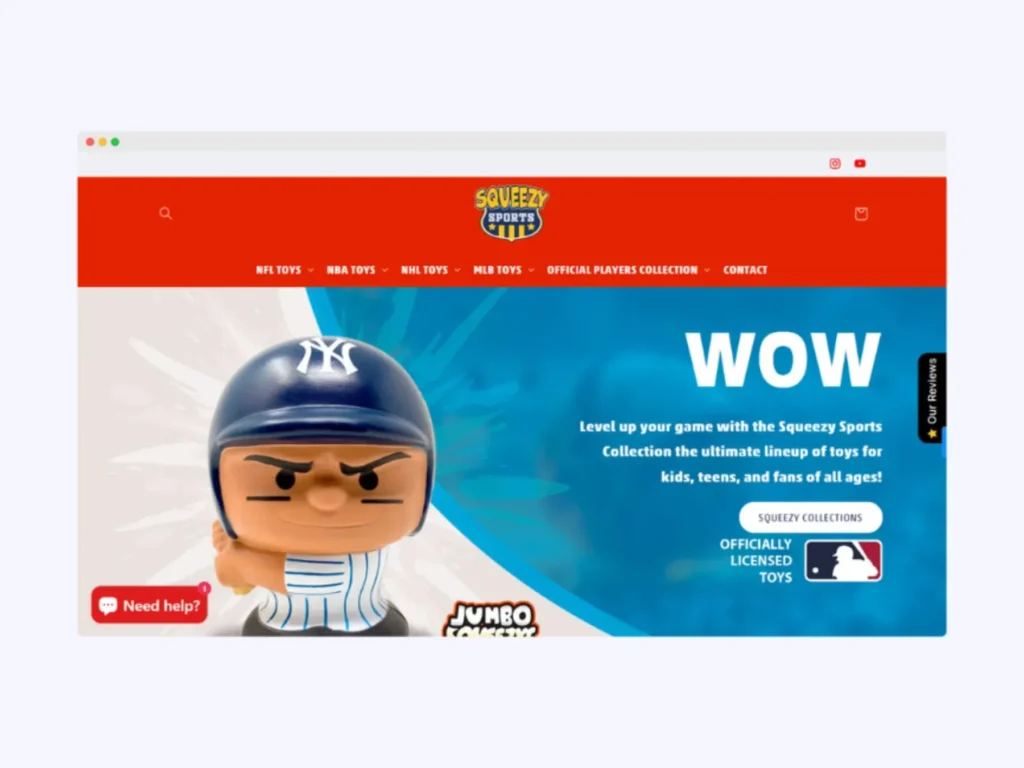
Squeezy Sports – Custom Shopify Website
Codefreex built a custom Shopify website for Squeezy Sports, a US toys and merchandise brand that had outgrown…
Client stories
Hear it from our clients
Real founders and teams on what it is like to build with Codefreex.


FAQ
Custom Ecommerce: FAQs
Straight answers to what buyers ask us most. Still unsure? Book a free 30-minute call.
Why choose custom ecommerce development over Shopify or WooCommerce?
Choose custom development when your workflows, product logic or growth plans outpace what a plugin-based platform allows. A custom build gives you full control over features, design, speed and scale, without stacking third-party apps to cover gaps. Codefreex also builds on Shopify and WooCommerce, so we recommend those platforms when they fit and a custom platform when your model needs rules they cannot handle cleanly.
How long does it take to build a custom ecommerce store?
A basic custom store or MVP typically takes 3–4 weeks, while a marketplace or a store with complex backend logic takes 6–10 weeks. The exact timeline depends on scope, integrations and how quickly feedback comes back. Codefreex shares a detailed project roadmap upfront and works in agile sprints with full transparency, so you always know what ships next.
How much does custom ecommerce development cost?
Cost depends on scope: the number of custom features, integrations, user roles and the volume of data to migrate. An MVP with a focused feature set costs far less than a full multi-vendor marketplace. Codefreex provides a free, detailed quote after a 30-minute discovery call and can plan an MVP-first release if you want to launch sooner and expand later.
What technology stack do you use for custom ecommerce builds?
Most Codefreex custom stores run on MERN (MongoDB, Express, React, Node.js), Laravel with Vue, or Next.js with PostgreSQL. For marketplaces and high-scale platforms, we add microservices architecture, Redis caching and headless APIs. The final choice depends on your catalog size, integrations and expected traffic, and we explain the trade-offs before you commit.
Can my team manage the store without a developer after launch?
Yes. Codefreex builds intuitive admin dashboards for orders, products, inventory, customers and reports, then trains your team to run them day to day. If your marketing team edits content often, we can connect a headless CMS so pages, banners and blog posts change without touching code, leaving developer time for genuinely new features.
Can you build a multi-vendor marketplace like Amazon or Etsy?
Yes. Codefreex builds multi-vendor marketplaces with vendor registration and dashboards, product sync, commission rules, order routing and a central admin panel for approvals and reporting. We typically use Laravel or React with Node.js for marketplace builds and design the data model so new vendors and categories can be added without slowing the platform down.
Do you provide support and scaling after the store goes live?
Yes. Codefreex offers maintenance plans that cover bug fixes, feature updates, cloud and server scaling, performance monitoring and DevOps automation with CI/CD pipelines, GitHub and Docker. You keep working with the same internal team that built the platform, so new features ship faster and nobody has to relearn your codebase from scratch.
Free estimate
Ready to build without platform limits?
Tell us what your store must do. We will scope the build, recommend a stack and send a free, detailed quote.
- A senior strategist reviews your request, not a sales bot
- Clear scope, timeline and estimate within one business day
- Free 30-minute discovery call, no obligation
- NDA available on request
- Emailhello@codefreex.com
- CallUSA +1 (209) 375-3475 · India +91 790 3375 530
- Prefer to talk?Book a 30-minute call
Keep exploring
Related services
Ecommerce Development
Codefreex builds and optimizes online stores on Shopify Plus, Magento, WooCommerce or a custom platform, connected to your marketplaces, ERP and CRM, and designed to convert.
ExploreMarketplace Integration
Codefreex connects your store, ERP or WMS to Amazon, Walmart, eBay, Etsy, Wayfair and Target Plus with real-time product, inventory and order sync, so overselling and copy-paste work stop.
ExploreFull Stack Development
Codefreex designs, builds and deploys complete web applications with React, Next.js, Node.js, Laravel and PostgreSQL, with one team owning your stack from database to interface.
Explore