
For years, digital advertising has largely meant one of three things: Google when somebody searches, Meta when somebody scrolls, and LinkedIn when somebody is in a professional mindset.
ChatGPT creates a different advertising moment.
Someone might ask:
“What’s the best CRM for a five-person sales team?”
“Which accounting software should I use for my ecommerce business?”
“Help me choose a laptop for video editing.”
“What’s the easiest way to automate LinkedIn outreach?”
That person is not casually scrolling through a feed. They are actively explaining a problem, comparing options and moving toward a decision.
That is what makes ChatGPT Ads interesting.
OpenAI has now expanded its advertising platform considerably, including self-service access through OpenAI Ads Manager Beta in supported markets, including India.
And unlike traditional search advertising, ChatGPT Ads are not simply triggered by bidding on an exact keyword.
The platform can understand the context and intent behind a conversation.
So how do you actually run ChatGPT Ads?
Let’s go through the process from account creation to optimization.
What Are ChatGPT Ads?
ChatGPT Ads are sponsored placements displayed within the ChatGPT experience.
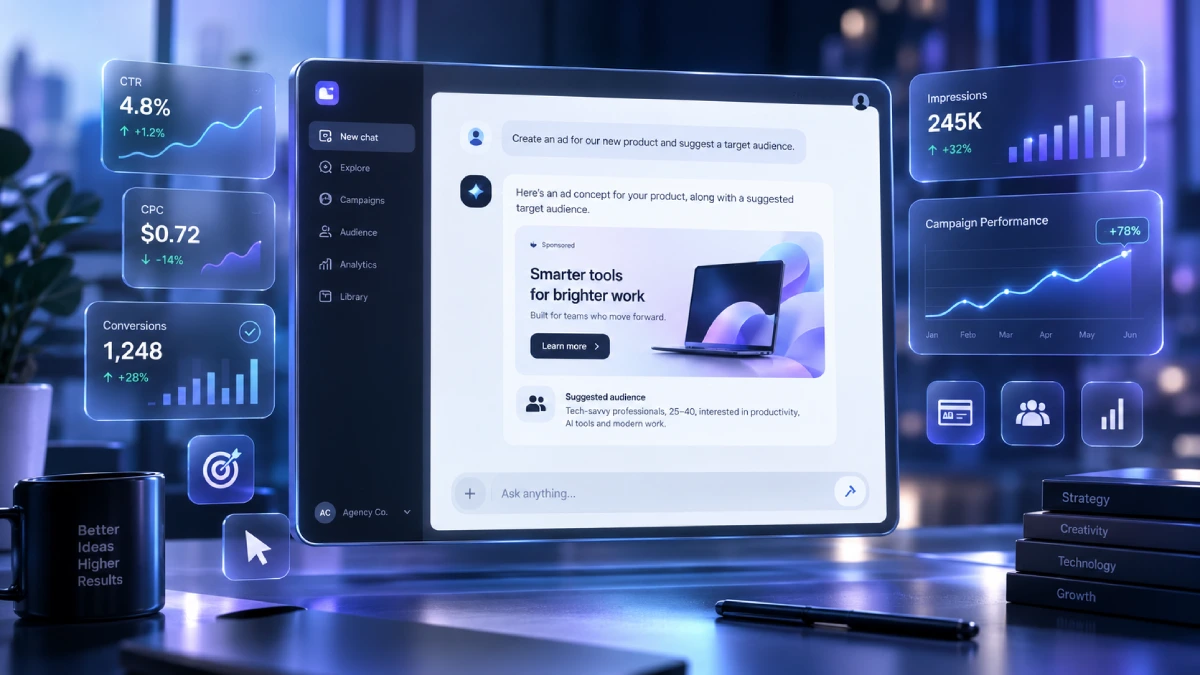
At present, ads can appear underneath a ChatGPT response and are clearly separated from the answer itself. An ad can include the advertiser’s name, favicon or logo, headline, description, landing page and image creative.
This distinction matters.
Advertisers are not paying ChatGPT to change its normal answers.
OpenAI says advertising remains separate from responses, and advertisers do not receive users’ private ChatGPT conversations.
Instead, ChatGPT tries to determine whether an eligible advertisement is relevant to what the person is currently trying to accomplish.
Imagine somebody asks ChatGPT:
“I run a Shopify store and need software that can automatically generate product descriptions.”
A SaaS company offering AI-powered ecommerce content generation could potentially be relevant to that conversation.
That’s closer to intent advertising than traditional keyword advertising.
Why ChatGPT Advertising Is Different From Google Ads
The easiest mistake marketers can make is treating ChatGPT Ads like another version of Google Search Ads.
It isn’t.
On Google, advertisers often build campaigns around search terms.
For example:
best CRM software
CRM for small business
cheap CRM
sales CRM software
The intent normally has to be inferred from a relatively short search query.
ChatGPT conversations can contain far more context.
Someone might instead say:
“We’re a seven-person B2B agency using spreadsheets to track leads. We need something simple with email automation but Salesforce is too complicated.”
That’s dramatically richer commercial context.
ChatGPT Ads can consider signals including the current conversation’s context and intent, the advertisement, landing page and advertiser-provided context hints. Where ad personalization is enabled, additional permitted signals from the user’s broader ChatGPT experience may also be considered.
This changes how advertisers should think about targeting.
You are not simply asking:
Which keywords should I bid on?
You should be asking:
During which conversations would my product genuinely be useful?
That is a much better starting point.
Where Are ChatGPT Ads Available?
OpenAI has been progressively expanding ChatGPT advertising throughout 2026.
As of September 2026, OpenAI lists self-service Ads Manager availability across markets including the United States, United Kingdom, India, Australia, Canada, Brazil, Japan, South Korea and a large number of European and Middle Eastern countries.
Availability will almost certainly continue changing, so check OpenAI Ads Manager before planning a campaign around a particular country.
For users, OpenAI currently says ads are not displayed to Plus, Pro or Business plan users or accounts identified as belonging to people under 18.
That is worth remembering when estimating potential audience size.
Step 1: Create Your ChatGPT Ads Manager Account
Start by opening OpenAI’s ChatGPT Ads platform and creating an advertiser account.
You need an OpenAI account.
During onboarding, expect to provide information such as:
- Business name
- Business website
- Industry
- Business country
- Currency
- Time zone
- Brand logo
- Billing information
OpenAI also has an advertiser verification process.
Once your information has been submitted, the account may be reviewed before full advertising access is granted.
After approval, complete the account information and billing setup before attempting to launch a campaign.
One important detail for agencies: advertisers should generally have their own advertiser account. Agencies can then be invited to manage it rather than simply creating every client under one shared account.
That is a sensible structure anyway. It keeps ownership, billing and access much cleaner.
Step 2: Install Conversion Tracking Before Spending Money
Do this before creating your first campaign.
Seriously.
Running ads first and figuring out attribution later is one of the easiest ways to waste an advertising budget.
ChatGPT Ads supports conversion measurement using the OpenAI Pixel, the Conversions API, or a combination of both.
Depending on your business, track actions such as:
- Lead form submissions
- Trial registrations
- Account creations
- Purchases
- Qualified enquiries
- Demo requests
- Completed checkouts
For a WordPress website, this typically means installing the relevant tracking code and ensuring the correct event fires when somebody completes an important action.
For example:
Visitor clicks ChatGPT ad → lands on service page → submits consultation form → conversion event fires.
Do not optimize around clicks if the actual business objective is enquiries.
A campaign generating 500 cheap visitors but zero qualified leads is not a successful campaign.
Step 3: Choose the Right Campaign Objective
ChatGPT Ads currently supports three core campaign objectives:
Views
Designed primarily for reach and visibility.
You pay based on impressions using CPM pricing.
This can make sense for brand awareness, product launches and broader market education.
Clicks
Designed for sending traffic to your website.
You pay for valid clicks using CPC pricing.
For many companies testing ChatGPT Ads for the first time, this is one of the simplest objectives to understand.
Conversions
Designed to optimize delivery toward a conversion event you configure.
This is usually more interesting once your conversion tracking is working correctly and you have a clear action worth optimizing toward.
For lead-generation businesses, I would structure the funnel around an actual enquiry, booking or registration rather than treating website traffic as the ultimate KPI.
How Much Do ChatGPT Ads Cost?
There is no universal “ChatGPT ad costs exactly X” answer.
Pricing is auction-driven.
Advertisers configure bids and budgets, while delivery depends on factors including competition and relevance.
OpenAI currently recommends that CPC campaigns consider starting with a maximum bid around $3–$5 per click, although your actual cost may differ.
There are also minimum campaign budgets.
For INR accounts, OpenAI currently lists a ₹725 minimum daily budget. The current USD minimum is $25 per day.
These figures can change as the platform develops, so always check Ads Manager rather than treating an old blog post as permanent pricing documentation.
And don’t automatically choose the lowest possible bid.
ChatGPT Ads uses a relevance-weighted auction. Your advertisement still needs to be useful and relevant to the conversation in which it could appear.
Step 4: Build Focused Ad Groups
This is where ChatGPT advertising starts becoming different.
Instead of throwing every product, use case and customer into one ad group, organize campaigns around distinct customer problems.
Suppose you sell project-management software.
Instead of one generic group called:
Project Management
you might create:
Project Management for Agencies
Remote Team Collaboration
Project Management for Developers
Client Approval Workflow
Alternative to Spreadsheets
Each represents a different conversational context.
This also makes it much easier to write relevant ads and landing pages.
Step 5: Write Strong Context Hints
Context hints help ChatGPT understand conversations where your advertisement could be relevant.
They are not simply exact-match keywords.
Think about the problems, questions and situations surrounding your product.
If Codefreex were promoting an AI implementation service, for example, relevant themes could include situations where businesses are discussing:
- Building an AI chatbot
- Automating customer support
- Creating AI sales agents
- Integrating an LLM into existing software
- Automating repetitive workflows
- Adding AI capabilities to a SaaS product
The objective isn’t to stuff every possible keyword into the system.
Describe the context in which the offer genuinely makes sense.
Step 6: Create Ads That Actually Help
Traditional advertising encourages clever headlines.
ChatGPT advertising rewards clarity.
OpenAI’s own creative guidance recommends benefit-focused advertisements that clearly explain what the product does, who it is intended for and why it might be useful.
Compare these:
Weak
Transform Your Future Today
What does that actually mean?
Almost nothing.
Better
Generate SEO Landing Pages From Your CSV
Create location and service pages in WordPress using reusable templates, dynamic variables and AI-assisted content.
The second version immediately tells the reader what the product does.
That matters in an environment where users are already trying to solve a specific problem.
Create multiple meaningful variations too.
Don’t create five ads where only one adjective changes.
Test different value propositions:
Problem-focused
Reduce the hours your team spends manually qualifying inbound leads.
Outcome-focused
Turn more website enquiries into booked sales calls.
Feature-focused
Connect your CRM, website and AI agent into one automated qualification workflow.
Each version gives the advertising system another meaningful angle to work with.
Step 7: Build a Landing Page That Matches the Conversation
This may become one of the biggest differences between average and high-performing ChatGPT campaigns.
Suppose your advertisement says:
AI Customer Support Agent for Shopify Stores
but sends visitors to a homepage that says:
Innovative Digital Transformation Solutions
You have created unnecessary friction.
The person now has to figure out whether you actually provide what they were looking for.
Your landing page should continue the same conversation.
A strong landing page should quickly answer:
- What exactly do you provide?
- Who is it for?
- What problem does it solve?
- How does it work?
- Why should somebody trust you?
- What should they do next?
Then give them one clear primary action.
Book a demo.
Start a trial.
Request a quote.
Buy now.
Get an audit.
Don’t make somebody arriving with high intent search through six navigation menus to figure out what to do.
Step 8: Add UTM Tracking
Even if you use OpenAI’s native conversion reporting, add UTMs to your landing-page URLs.
For example, you might structure tracking around:
utm_source=chatgpt
utm_medium=paid
utm_campaign=ai_services
utm_content=ai_agent_ad
OpenAI confirms static URL tracking parameters can be used with ChatGPT Ads.
This allows you to compare ChatGPT advertising inside GA4 or your existing analytics stack.
You want to know more than how many clicks arrived.
Look at:
- Engagement
- Lead quality
- Conversion rate
- Cost per lead
- Qualified lead rate
- Revenue
- Customer acquisition cost
- ROAS
A cheap click that never converts is still expensive.
Step 9: Launch Small and Learn
Do not create twenty campaigns on your first day.
Start with one commercial objective.
One audience problem.
A small collection of genuinely different creatives.
A dedicated landing page.
Correct tracking.
Then learn.
OpenAI Ads Manager currently reports metrics including impressions, clicks, spend, CTR, average CPC, average CPM and conversions when conversion measurement is configured.
Once enough data accumulates, start comparing:
Which context generates the most qualified visitors?
Which headline attracts the right people?
Which landing page converts?
Which offer produces actual revenue?
Then expand what works.
That sounds obvious, but it is exactly where many advertisers fail. They scale traffic before proving economics.
What About Retargeting and Customer Audiences?
ChatGPT Ads is already becoming more sophisticated than its initial rollout.
OpenAI supports Custom Audiences using eligible customer or prospect data such as email addresses, phone numbers and certain hashed identifiers.
These audiences can be used for inclusion, exclusion and some bid-adjustment workflows.
OpenAI currently requires at least 25,000 matched users for inclusion audiences or audience-level bid adjustments and recommends audiences of at least 100,000 users for those use cases. Smaller audiences can still have uses such as exclusions.
For larger advertisers, this opens interesting possibilities.
You could exclude existing customers from acquisition advertising or increase bids around higher-value audience segments.
ChatGPT Ads Are Moving Beyond Simple Display Ads
The platform is evolving quickly.
On September 16, 2026, OpenAI announced testing of Sponsored Agents, where someone can click an advertisement and start a conversation with a business-sponsored AI agent. OpenAI also announced additional AI creative capabilities and advertising integrations involving platforms including HubSpot and Shopify.
This is where conversational advertising starts becoming genuinely different.
Instead of:
Advertisement → landing page → form
the future journey could increasingly look like:
Advertisement → AI conversation → questions answered → qualification → product selection → conversion.
That is a much more interactive customer journey than the typical display advertisement.
How I Would Test a First ChatGPT Ads Campaign
If I were launching a new campaign with a limited budget, I would keep the first experiment deliberately simple.
Start with one offer that already converts elsewhere.
Create a landing page specifically around that offer.
Install conversion tracking.
Choose one primary market.
Create three to five distinct advertisements.
Write context hints around real customer problems rather than huge keyword lists.
Launch with a controlled budget.
Then judge the campaign on qualified conversions, not vanity metrics.
After enough data:
Pause poor messages.
Expand winning angles.
Improve the landing page.
Add conversion data.
Experiment with new contexts.
Scale gradually.
The goal of your first campaign isn’t domination.
It is finding evidence that a repeatable acquisition channel exists.
ChatGPT Ads vs Google Ads: Should You Replace Google?
Probably not.
Think of ChatGPT as another layer in the acquisition stack rather than automatically replacing search.
Google captures people searching the web.
Meta can create demand while people consume content.
LinkedIn can reach people using professional attributes.
ChatGPT can potentially reach people while they are actively describing a problem, exploring alternatives and asking for help making a decision.
Those are different moments.
The strongest marketing strategy will often connect several of them.
Someone could discover your company through ChatGPT, research your brand on Google, read your website, see a retargeting advertisement and convert several days later.
Attribution will rarely be as clean as marketers would like.
SEO and ChatGPT Ads Should Work Together
Paid visibility inside AI platforms does not remove the need for organic visibility.
In fact, businesses should increasingly think about three layers:
Traditional SEO — Can Google find and rank you?
AEO / AI visibility — Can answer engines understand and cite your company?
AI advertising — Can you pay to reach relevant audiences during commercial conversations?
The companies building all three now are creating a broader discovery strategy instead of depending on one traffic source.
Common ChatGPT Advertising Mistakes to Avoid
The platform may be new, but many of the mistakes will look familiar.
Sending all advertisements to the homepage. Build a landing experience around the actual offer.
Writing vague AI-generated copy. Clear value propositions beat meaningless marketing language.
Skipping conversion tracking. Traffic without measurement teaches you very little.
Treating context hints like Google keywords. Think about customer situations and intent.
Launching too many campaigns. Concentrated learning is more useful than fragmented data.
Optimizing exclusively for CTR. A high click-through rate doesn’t matter if none of those visitors become customers.
Changing campaigns every few hours. Give your tests enough data to produce meaningful patterns.
Is ChatGPT Advertising Worth Testing in 2026?
For businesses with a proven offer and functioning conversion funnel, ChatGPT Ads deserves attention.
The important part isn’t simply that ChatGPT is another large platform.
It is when the advertising opportunity occurs.
People use conversational AI to investigate problems, understand products, compare alternatives and make decisions.
Those moments can carry strong commercial intent.
But the same rule that applies to Google, Meta and LinkedIn still applies here:
Advertising cannot rescue a weak offer.
Before increasing spend, make sure you have:
- A clear product or service
- A defined customer
- A convincing value proposition
- A strong landing page
- Reliable conversion tracking
- A follow-up process
- A method for measuring revenue
Get those right first.
Then ChatGPT Ads becomes another acquisition channel you can test, measure and potentially scale.
Need Help Running Your First ChatGPT Ads Campaign?
ChatGPT Ads combines advertising strategy, tracking, landing-page optimization, AI positioning and conversion-rate optimization.
At Codefreex, we help businesses build measurable digital growth systems across performance marketing, AI implementation, conversion-focused websites and automation.
Whether you need help configuring campaign tracking, designing a high-converting landing page or building an end-to-end AI-powered acquisition funnel, our team can help you structure the campaign around actual business outcomes rather than clicks alone.
Talk to Codefreex about your AI advertising strategy.
Frequently Asked Questions About ChatGPT Ads
Can you advertise on ChatGPT?
Yes. OpenAI currently offers ChatGPT advertising through its Ads Manager platform in supported countries, including India, the United States, United Kingdom and multiple other markets.
How much do ChatGPT Ads cost?
ChatGPT Ads uses auction-based pricing. OpenAI currently supports CPM and CPC-based buying, as well as conversion-oriented campaign optimization. CPC guidance currently suggests an initial maximum bid around $3–$5 per click, although actual pricing varies.
What is the minimum budget for ChatGPT Ads?
Minimum budgets depend on account currency. OpenAI currently lists ₹725 per day for INR campaigns and $25 per day for USD campaigns.
Are ChatGPT Ads based on keywords?
Not exactly. Advertisers can provide context hints containing topics, conversations and keywords that help OpenAI understand when an advertisement may be relevant. These are not traditional exact-match search keywords.
Where do ChatGPT Ads appear?
OpenAI states that advertisers do not receive users’ private conversations and that user data is not sold to advertisers.
Ads can appear beneath ChatGPT responses. They are labeled as advertisements and remain separate from ChatGPT’s normal answers.
Can ChatGPT advertisers read users’ conversations?
Can I track conversions from ChatGPT Ads?
Yes. OpenAI supports conversion measurement through the OpenAI Pixel, Conversions API and supported measurement integrations.
Does ChatGPT Ads work with WordPress websites?
Yes. A WordPress website can be used as the campaign landing page. Advertisers should configure appropriate conversion tracking and optimize landing pages for the campaign’s intended action.