
API development
API Development Services That Connect Every System You Run
We design, build and document REST and GraphQL APIs, connect your platforms to Stripe, HubSpot, Shopify, Salesforce and your ERP, and keep every integration secure and monitored.
Quick answer
What do Codefreex’s API development services include?
Codefreex API development services include REST and GraphQL API design and development, webhooks, third-party integrations with platforms such as Stripe, HubSpot, Shopify, Salesforce and ERPs, API security with OAuth 2.0 and rate limiting, OpenAPI documentation, versioning and monitoring. We build APIs for products, partners and internal systems, then test, document and support them after launch.
540+
Projects delivered
9+
Years in business
23+
Certified experts




Trusted by 540+ growing businesses worldwide












API Development & Integration
Your systems should share data without anyone copying it
Most businesses run on a dozen platforms that each hold part of the truth. Orders sit in Shopify, customers in HubSpot, invoices in QuickBooks and stock levels in an ERP. When those systems do not talk to each other, people fill the gap with CSV exports, copy-and-paste and nightly spreadsheets, and every manual step is another chance for a costly error.
Codefreex designs and builds the APIs and integrations that let your systems share data reliably. That might be a public API for your SaaS product, a private API behind your mobile app, or a set of integrations that sync orders, contacts and payments across platforms in real time. Each one is secured, documented with OpenAPI, versioned and monitored, so you know immediately when something fails.
What you get
API services we deliver
From a single webhook to a full public API, every build is designed for security, clear documentation and long-term maintenance.
REST API Development
Resource-based REST APIs with consistent naming, pagination, filtering, error formats and idempotent writes, built in Node.js, Laravel or Python so other developers can integrate without guesswork.
GraphQL API Development
GraphQL schemas and resolvers for front ends and mobile apps that need flexible queries, with depth limits, batching to avoid N+1 lookups and persisted queries for performance.
Third-Party Integrations
We connect Stripe, HubSpot, Shopify, Salesforce, QuickBooks, NetSuite and other ERPs, handling authentication, field mapping, retries and conflict rules so records stay consistent on both sides.
Webhooks and Event Pipelines
Signed webhooks, queues and background workers that react to new orders, payments or form submissions in real time, with retries and dead-letter handling when an endpoint is down.
API Security
OAuth 2.0 and OpenID Connect, scoped API keys, rate limiting, input validation and audit logging, designed against the OWASP API Security Top 10 risks from the very first endpoint.
Documentation and Monitoring
OpenAPI specifications, interactive reference docs and Postman collections, plus versioning policies, uptime checks, latency tracking and alerts, so partners integrate quickly and your team spots failures first.
Platforms and tools we work with
How we work
How we build and ship APIs
Clear phases, a named owner for every deliverable and weekly progress you can see.
Map Systems and Data
We document every system involved, the data each one owns, the events that trigger syncs and your security requirements, then agree on scope and success criteria.
Design the Contract
We write the OpenAPI or GraphQL schema first, review it with your developers and partners, and lock naming, errors, authentication and versioning before implementation begins.
Build and Test
We implement endpoints and integrations with automated tests, sandbox testing against each third-party platform, load testing for busy endpoints and a security review before launch.
Launch and Monitor
We deploy with logging, alerts and dashboards for errors and latency, publish documentation, and support the API as platforms release new versions and your needs change.
Who it is for
Where API development pays off
SaaS products
Software companies launching a public API, partner integrations or a developer portal so customers can connect the product to their own stack.
Ecommerce operations
Stores syncing orders, inventory and customers between Shopify or WooCommerce, the ERP, the warehouse and the CRM without manual exports.
Mobile and web apps
Products that need a secure, fast back-end API to power iOS, Android and web front ends from one shared source of data.
Finance and back office
Teams connecting Stripe, QuickBooks, Xero or NetSuite so payments, invoices and refunds reconcile automatically instead of through spreadsheets.
Why teams switch to us
Integration specialists vs. quick fixes
Typical agency
- Brittle scripts with no error handling
- No documentation beyond a short README
- Security left until after launch
- Silent failures nobody notices for weeks
 Codefreex
- Retries, idempotency and conflict rules built in
- OpenAPI specs, guides and Postman collections
- OAuth, rate limits and OWASP review from day one
- Monitoring and alerts on every integration
Buyer guide
API development and integration: a buyer’s guide
Whether you need a public API for your product or integrations between platforms you already pay for, these are the decisions that shape cost, reliability and long-term maintenance.
REST vs GraphQL: which API style fits
REST is the default for most APIs, and for good reason. It maps cleanly to resources such as orders or customers, works with standard HTTP caching, and every developer and integration tool understands it. If partners, customers or no-code platforms will consume your API, REST with an OpenAPI specification is usually the right choice, because it is the easiest style for outside developers to learn, test and debug.
GraphQL shines when your own front ends need flexible data. A mobile app can fetch a customer, their orders and loyalty status in one request instead of three, and the schema doubles as living documentation. The trade-offs are real: caching is harder, careless queries can overload the database, and rate limiting needs query cost analysis rather than simple request counts. Many products use both, with GraphQL internally and REST for partners.
What a production-ready API needs
An API that works in a demo is not the same as one that survives real traffic. Production APIs need consistent error responses, pagination for large lists, idempotency keys so a retried payment is not charged twice, and timeouts on every outbound call. They also need validation on every input field, structured logging with request IDs, and health checks that your hosting platform can watch and act on.
Versioning is the part teams forget until it hurts. Once a partner depends on your API, you cannot rename a field without breaking their integration. We version from day one, through URL paths or headers, publish a deprecation policy and keep old versions running long enough for consumers to migrate. A changelog and an OpenAPI diff on every release make breaking changes visible before they reach production.
Integrating Stripe, HubSpot, Shopify and ERPs
Every platform has its own quirks. Stripe is well documented and event-driven, so the work centers on verifying webhook signatures and processing events in the right order. HubSpot and Salesforce enforce rate limits and use custom objects and properties that differ in every account. Shopify offers REST and GraphQL Admin APIs with versioned releases you must keep up with. ERPs such as NetSuite or SAP often need middleware and careful field mapping.
The hard part is rarely the first sync. It is deciding which system owns each field, what happens when the same record changes in two places, and how failed syncs are retried without creating duplicates. We document those rules before writing code. For simpler flows, a platform like Make or Zapier can be faster and cheaper than custom code, and as a Make Partner, Codefreex recommends it whenever it fits.
API security essentials
APIs are one of the most common ways attackers reach data, usually through broken authorization rather than clever exploits. An endpoint that returns any customer’s order when someone changes the ID in the URL is a breach waiting to happen. We check object-level permissions on every request, use OAuth 2.0 with short-lived tokens and scoped API keys, and keep secrets in a managed vault instead of in code or config files.
Rate limiting protects you from abuse and runaway integrations, and it should vary by client and endpoint rather than rely on one global cap. Input validation, strict CORS rules, TLS everywhere and audit logs for sensitive actions round out the baseline. We review every API against the OWASP API Security Top 10 before launch, and for regulated data we add encryption at rest, field-level access controls and retention rules.
What drives API development cost and timelines
Cost depends on the number of endpoints and integrations, the complexity of the business rules behind them, data volumes, real-time versus batch syncing, and the quality of the systems on the other end. A webhook that posts Stripe payments into HubSpot is a small project. A public API with OAuth, multiple versions, developer documentation and service commitments to partners is a product in its own right.
Timelines follow the same logic. A single well-documented integration often goes live within a few weeks, while a full API platform is delivered in phases over a few months. The biggest delays come from outside the code: waiting for sandbox access, unclear ownership of data and undocumented legacy systems. Codefreex scopes each project on a free 30-minute call and sends a written estimate before any work starts.
Selected work
Proof from real projects
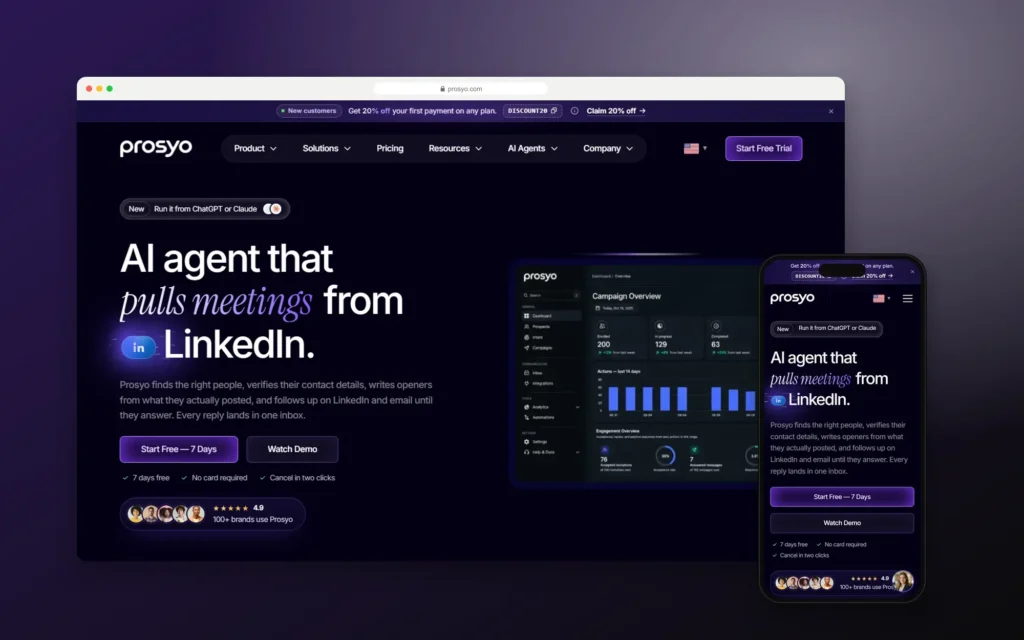
Prosyo – Building an AI LinkedIn and Email Outreach Platform Run from Chat
Codefreex built Prosyo, an AI outreach platform that runs LinkedIn and email prospecting in one campaign and can…

OnePloy – Building a Cloud Platform for Apps, Databases and AI
Codefreex built OnePloy, a cloud platform for deploying web apps, APIs, databases and AI services in one place.…
Client stories
Hear it from our clients
Real founders and teams on what it is like to build with Codefreex.


FAQ
API Development & Integration: FAQs
Straight answers to what buyers ask us most. Still unsure? Book a free 30-minute call.
How much does API development cost?
API development cost depends on the number of endpoints and integrations, the complexity of business rules, security and compliance needs, data volume and how well the connected platforms are documented. A single integration is a far smaller project than a public API with developer docs. Codefreex scopes each project on a free 30-minute call and sends a written estimate before work begins.
How long does it take to build an API or integration?
A single integration between two well-documented platforms often goes live within a few weeks. A complete API with authentication, documentation and multiple integrations is usually delivered in phases over a few months. Sandbox access, data ownership decisions and poorly documented legacy systems affect timing more than coding does, so we identify those risks during discovery.
What is the difference between REST and GraphQL?
REST exposes fixed endpoints for each resource, such as orders or customers, and works well with caching and outside developers. GraphQL exposes one endpoint where clients request exactly the fields they need, which suits complex front ends and mobile apps. Codefreex usually recommends REST for public and partner APIs and GraphQL for internal apps that need flexible data.
Can you integrate our systems with Stripe, HubSpot, Shopify or Salesforce?
Yes. We build integrations with Stripe, HubSpot, Shopify, Salesforce, Zoho, QuickBooks, Xero, NetSuite and most platforms that offer an API. Codefreex is a Shopify Partner, Salesforce Partner and Zoho Authorized Partner. We handle authentication, field mapping, rate limits, retries and conflict rules, and we document which system owns each piece of data.
How do you secure an API?
We secure APIs with OAuth 2.0 or scoped API keys, object-level authorization checks on every request, rate limiting per client, input validation, TLS everywhere and secrets stored in a managed vault. Sensitive actions are written to audit logs. Before launch, every API is reviewed against the OWASP API Security Top 10, the standard list of the most common API vulnerabilities.
Do you write API documentation?
Yes. Every API we build ships with an OpenAPI specification for REST or a documented schema for GraphQL, interactive reference docs, authentication guides and example requests. We also provide Postman collections so developers can test calls right away. Documentation is generated from the code where possible, so it stays accurate as the API changes and new versions are released.
Should we use Zapier or Make instead of custom API development?
Use Zapier or Make when the workflow is simple, volumes are modest and both platforms are supported. They are faster and cheaper to set up. Choose custom development when you need complex logic, high volumes, strict security, real-time syncing or connections that no-code tools do not support. Codefreex is a Make Partner and recommends whichever option fits the job.
Can you build an MCP server so AI assistants can use our API?
Yes. The Model Context Protocol lets AI assistants such as ChatGPT and Claude call your API as tools, with your authentication and permissions in place. Codefreex has built MCP support into its own products, including Prosyo and OnePloy, and we can add an MCP server alongside your REST or GraphQL API so customers can work with your product from their AI assistant.
Free estimate
Connect your systems the right way
Tell us which platforms need to share data. We’ll map the integration and estimate the work for free.
- A senior strategist reviews your request, not a sales bot
- Clear scope, timeline and estimate within one business day
- Free 30-minute discovery call, no obligation
- NDA available on request
- Emailhello@codefreex.com
- CallUSA +1 (209) 375-3475 · India +91 790 3375 530
- Prefer to talk?Book a 30-minute call
Keep exploring
Related services
Custom Software Development
Internal tools, customer portals, dashboards and workflow apps designed for your exact processes, connected to the systems you already run, and built to grow with your team.
ExploreCRM Integration
We connect your CRM to your website, store, ads and support tools, then automate routing, follow-ups and reporting, as a Salesforce, Zoho Authorized, Odoo, Klaviyo and Make partner.
ExploreAI Agent Development
We design, build and deploy AI agents and chatbots that connect to your CRM, store and help docs, take real actions, and hand off to people when they should.
Explore